Core faculty / Active profile
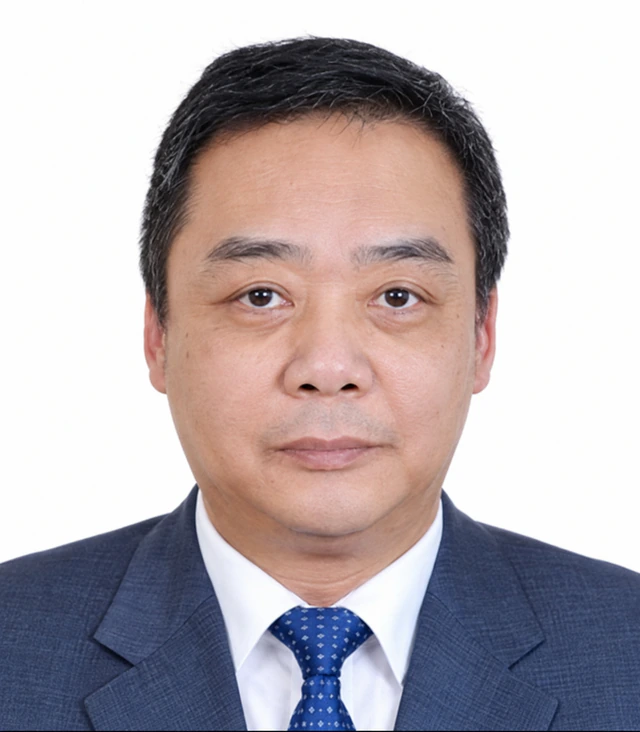
Jun Liu
Professor / Doctoral supervisor
ExpertiseRail transport organization and operational dispatching
BEIJING JIAOTONG UNIVERSITY · SCHOOL OF TRAFFIC AND TRANSPORTATION
We study maglev application planning, transport organization, train operation, dispatching and traction-power coordination, connecting scenario assessment with optimization, algorithms and system validation.
Core faculty / 03
Professor / Doctoral supervisor
Focus: Rail transport organization and operational dispatching
Professor / Doctoral supervisor
Focus: Rail transport organization and operational dispatching

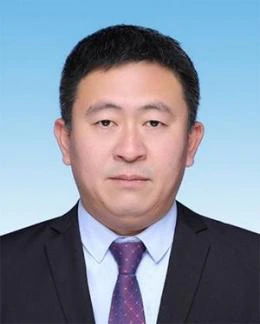
Assistant Professor / Master's supervisor
Focus: Transport organization and operation optimization for new rail systems
OUR TEAM / AT A GLANCE
OVERVIEW / 01
The team brings together faculty and researchers at different career stages, including professors and lecturers, along with current doctoral and master's students and alumni, forming a well-structured research talent pipeline.
OVERVIEW / 02
The team has published more than 30 papers, including multiple SCI-indexed papers and articles in leading journals, and has produced a range of intellectual property outcomes.
OVERVIEW / 03
The team contributes to projects related to the National Key Research and Development Program and multiple industry collaborations, with ongoing research in maglev transport organization and operation optimization.
01 / RESEARCH DIRECTIONS
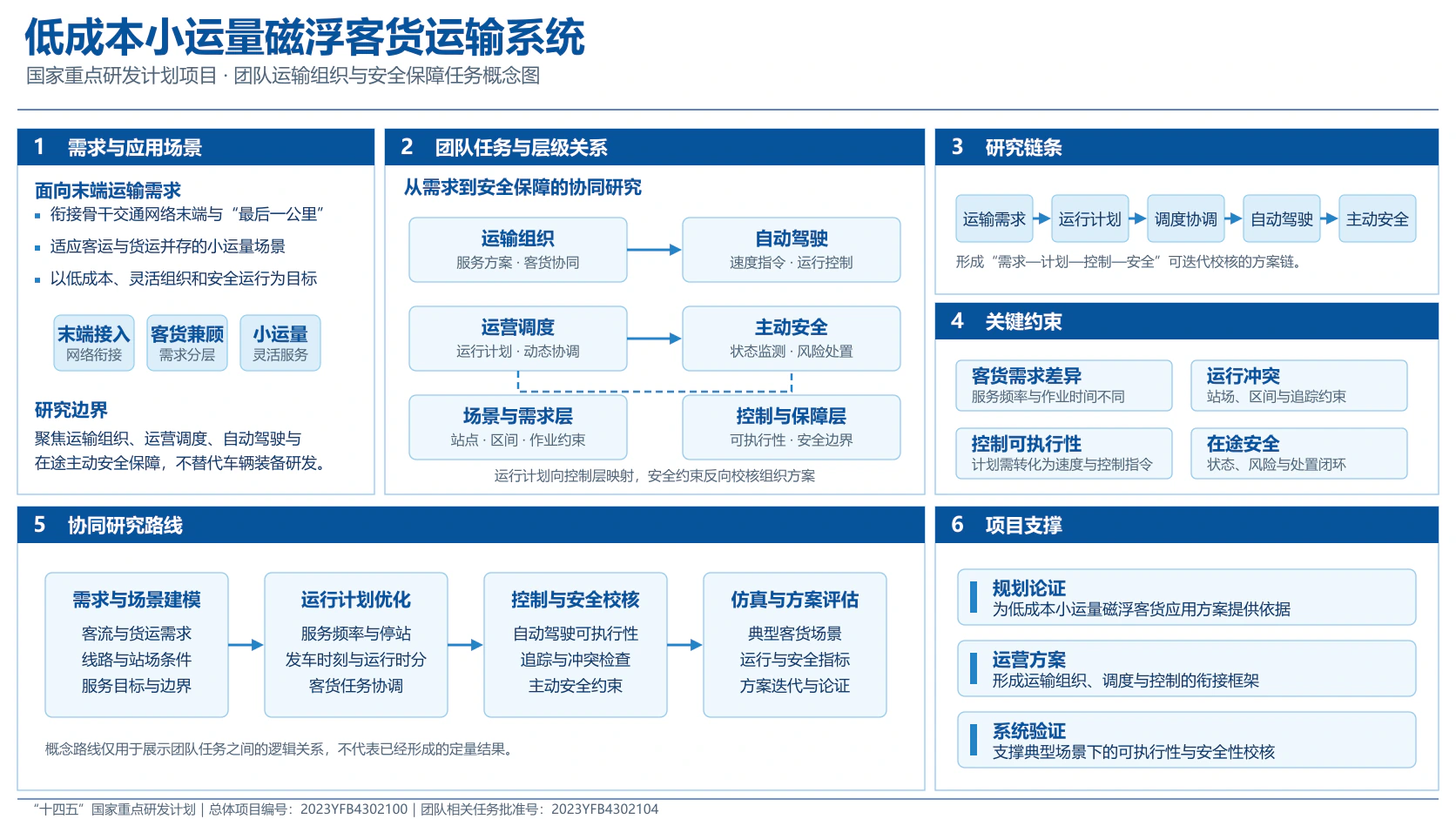
We study maglev application planning, transport organization, train operation, dispatching, and traction-power coordination, connecting scenario assessment with optimization, algorithms, and system validation.
Research on functional relations, interfaces, and techno-economic performance between high-speed maglev and existing high-speed rail networks supports maglev positioning, option comparison, and planning assessment.
Research on freight models, transport organization, system capacity, and cost for low-speed permanent-magnet maglev addresses urban logistics demand and supports freight scheme design and engineering planning.
Optimize traction, cruising, coasting, and braking under line and running-time constraints to produce maglev speed profiles balancing safety, punctuality, and total energy consumption.
Coordinate service frequency, stopping patterns, departure times, and section running times for future high-speed maglev operations and medium- and low-speed passenger and freight scenarios, with headway and line-capacity checks.
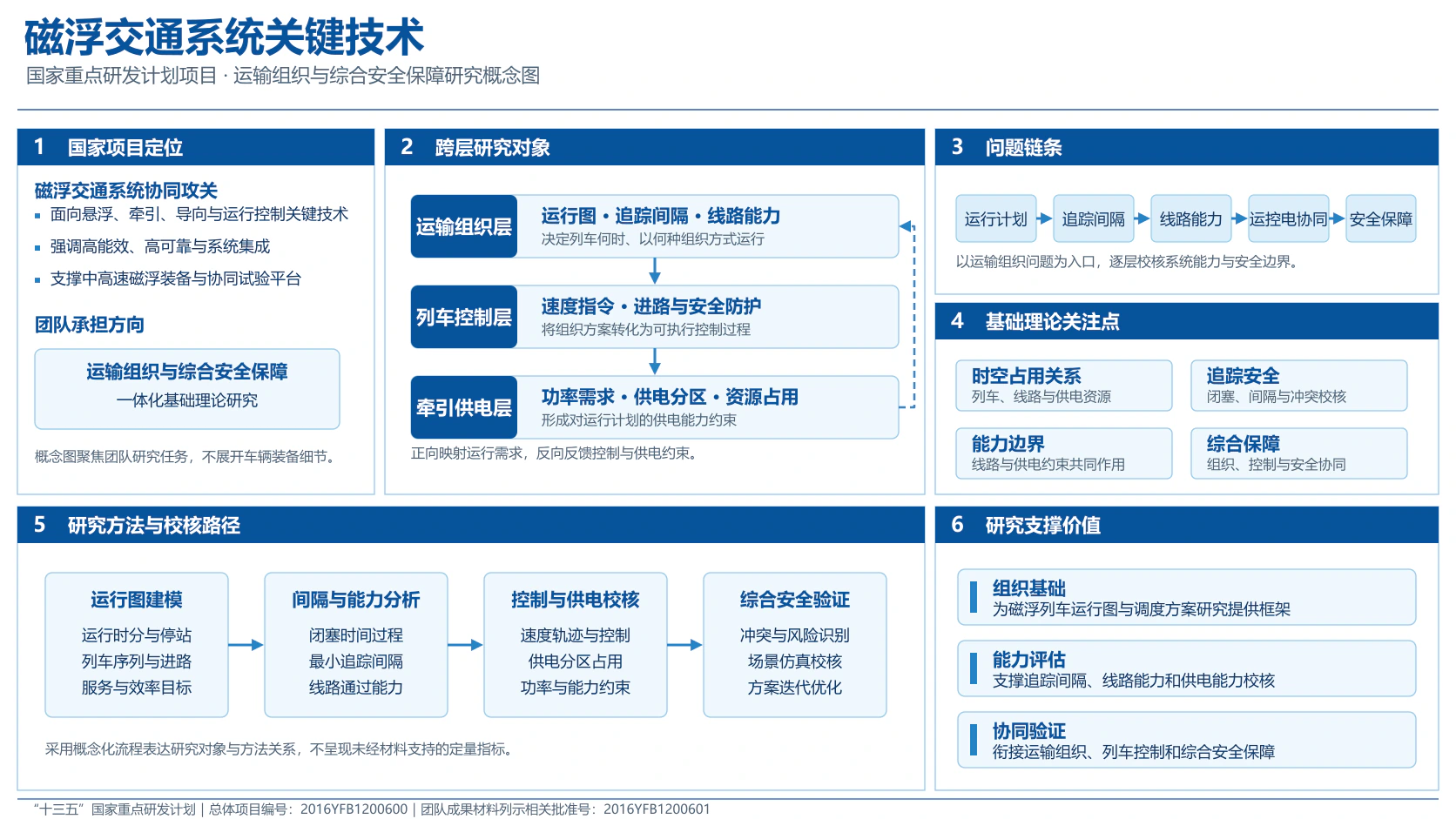
Address cross-layer coupling among transport organization, train control, and traction power by coordinating timetables, speed trajectories, supply capacity, and multi-train loads.
02 / RESEARCH PROJECTS
14th Five-Year National Key R&D Program on transport equipment and intelligent transportation
Project number / 2023YFB4302100
13th Five-Year National Key R&D Program on advanced rail transport
Project number / 2016YFB1200600
Industry collaborations and university-funded research
Industry-funded project
China State Railway Group
2022–2023
Study the relationship between high-speed maglev and existing high-speed rail networks, and compare the economics of alternative transport schemes.
Research on coordinated network development examines connections between different technologies and networks, and compares their economics to support maglev system planning and techno-economic analysis.
Industry-funded project
CRRC Tangshan
2024–2025
Develop freight models and transport organization schemes for low-speed permanent-magnet maglev applications.
Research on freight models and transport organization suited to low-speed permanent-magnet maglev demand supports scheme assessment and connects with maglev transport organization and line-capacity optimization.
Industry-funded project
CRRC Tangshan
2022–2023
Research key technologies in the operation and engineering applications of medium-speed maglev transport systems.
Study transport organization, operation optimization, and system coordination to address operating and engineering needs and support scheme assessment and further research.
University-funded project
Beijing Jiaotong University Talent Fund
2023–present
Study coupling between multi-train maglev operation and traction-power control, focusing on their mutual influence.
Research coupling mechanisms between train-fleet operation and traction-power control under multi-train conditions to support fleet organization and integrated operation-control-power research, particularly power coordination and supply optimization.
University-funded project
2026 BJTU Fundamental Research Funds Graduate Innovation Project
2026
Study coupling between high-speed maglev train plans and traction power, coordinating running times, speed trajectories, traction-power demand, and power-supply-zone states in an integrated operation and power-supply optimization framework.
Address mutual constraints between operating plans and supply capacity under high-speed operation, high traction power, and ground-based zoned supply, exploring integrated optimization that balances safety, transport efficiency, energy use, and power-supply feasibility.
Project lead:Wu Bai
03 / SELECTED OUTPUTS
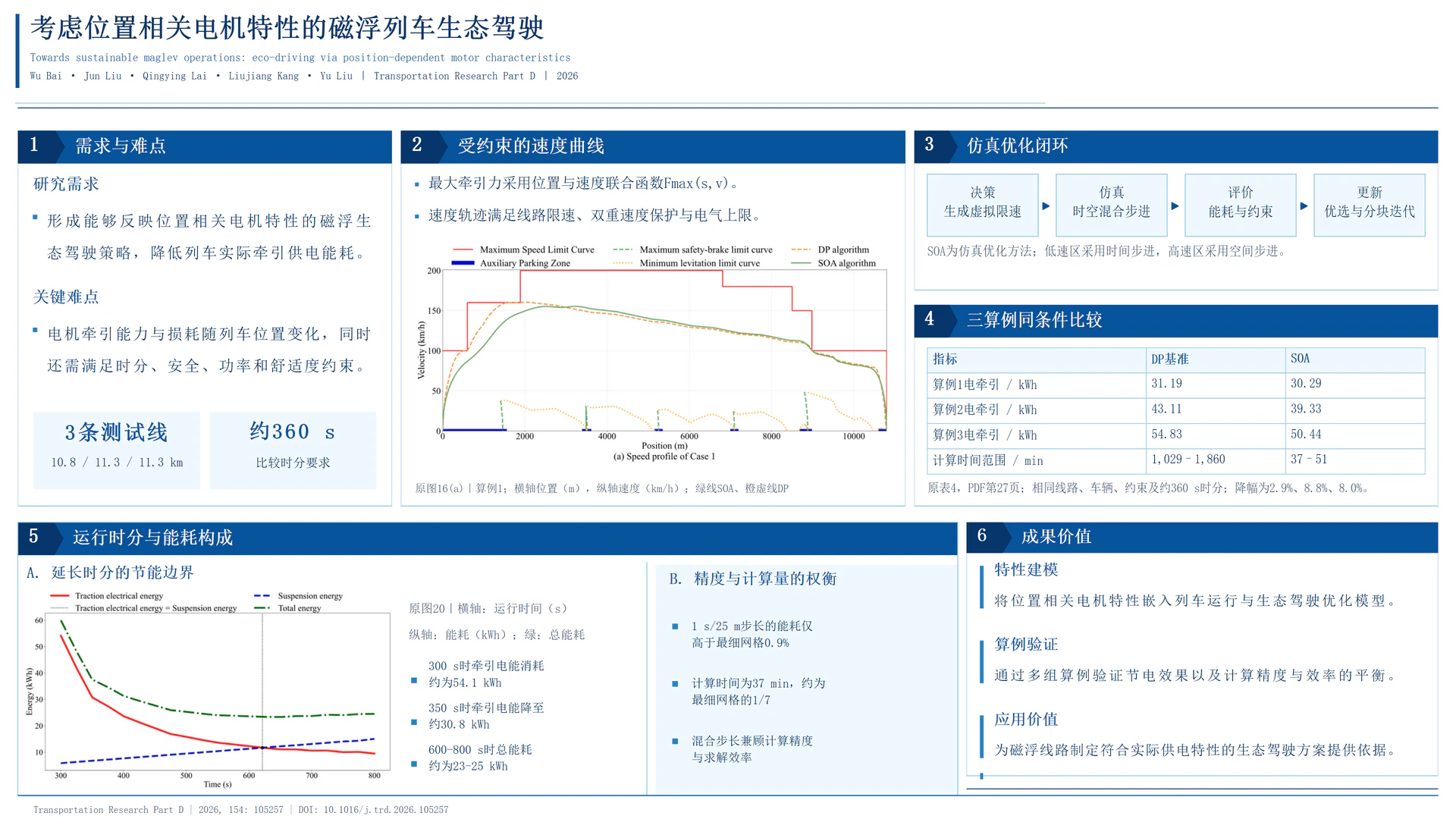
Towards sustainable maglev operations: eco-driving via position-dependent motor characteristics
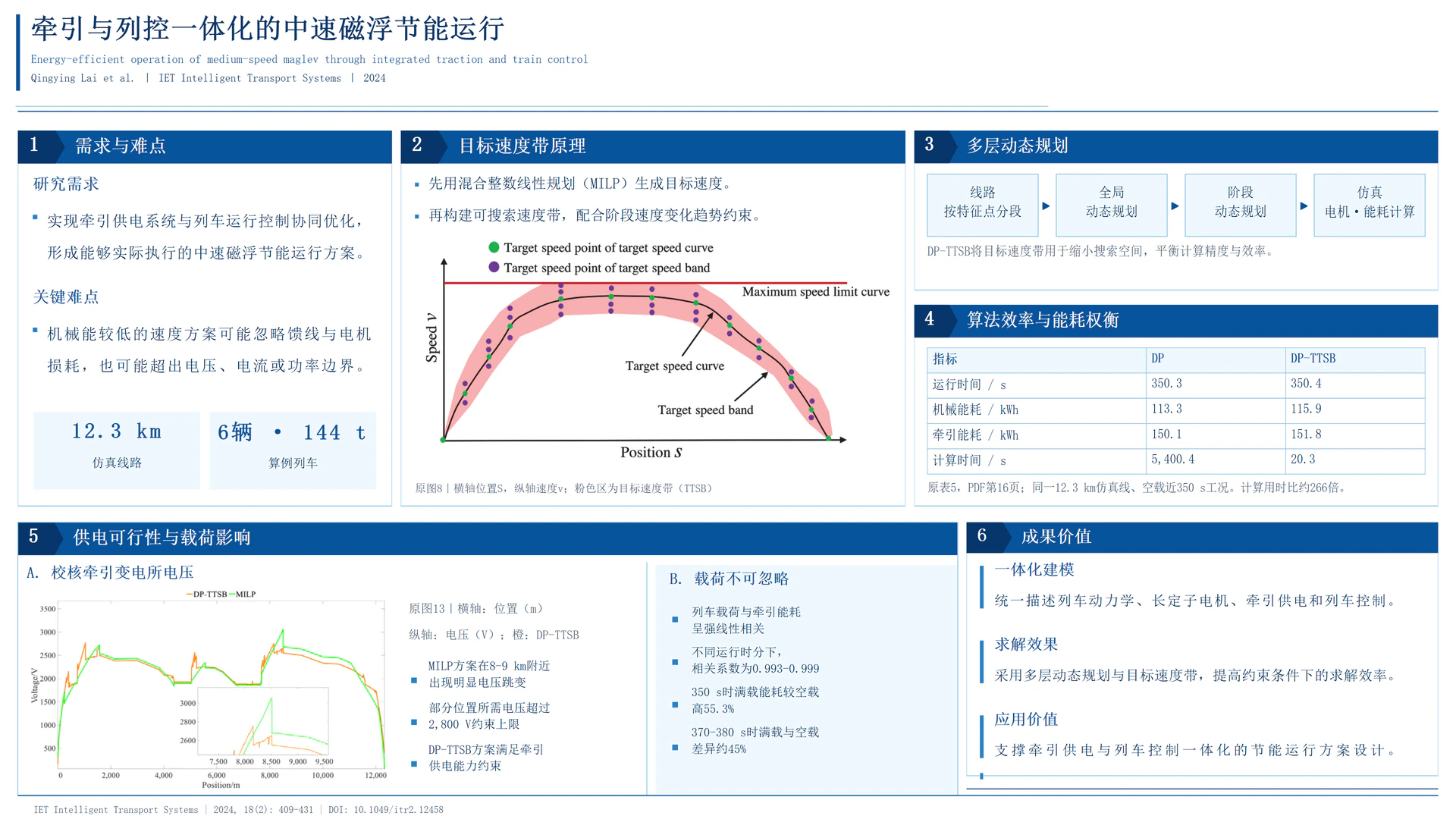
Energy-efficient operation of medium-speed maglev through integrated traction and train control
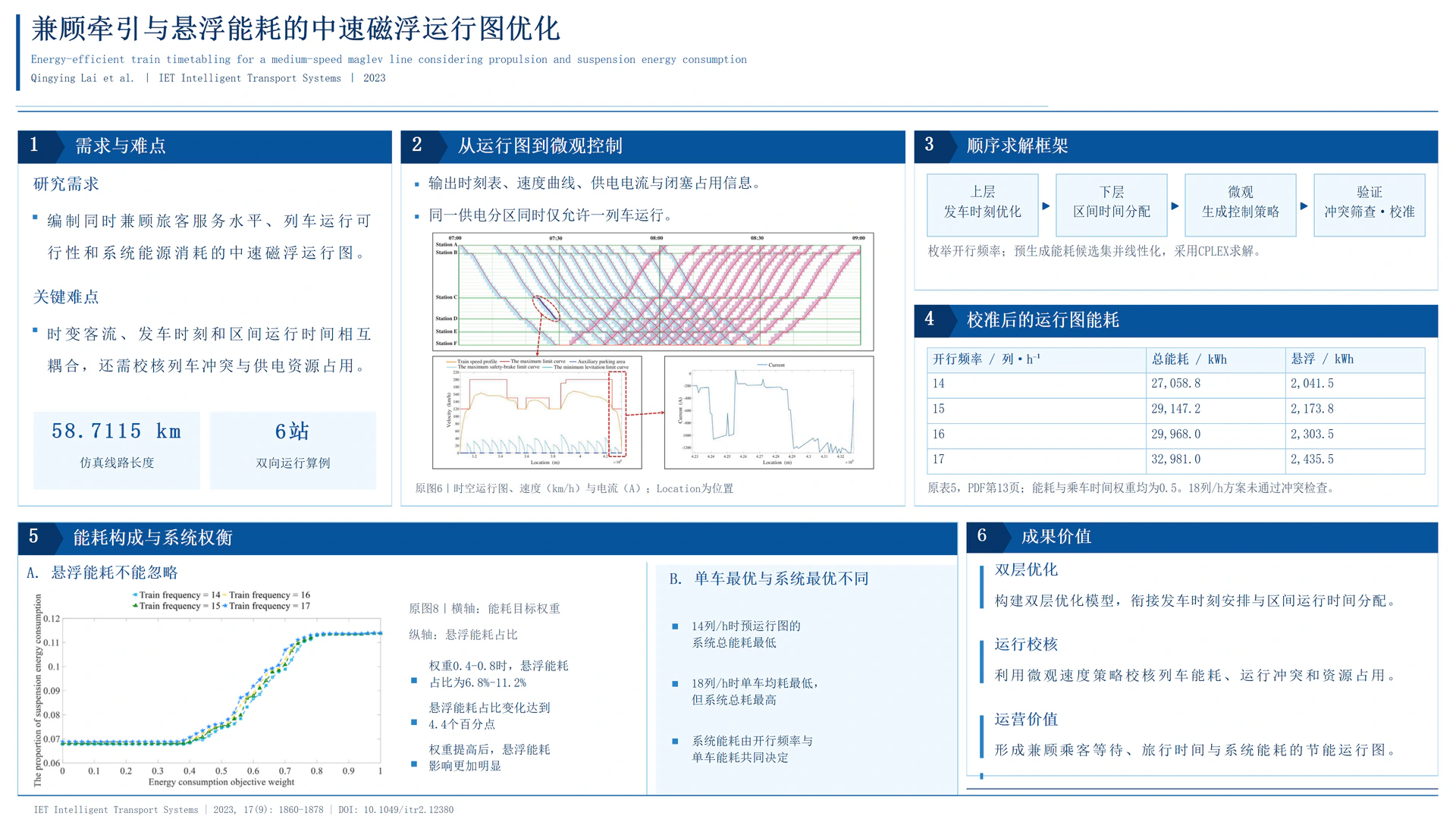
Energy-efficient train timetabling for a medium-speed maglev line considering propulsion and suspension energy consumption
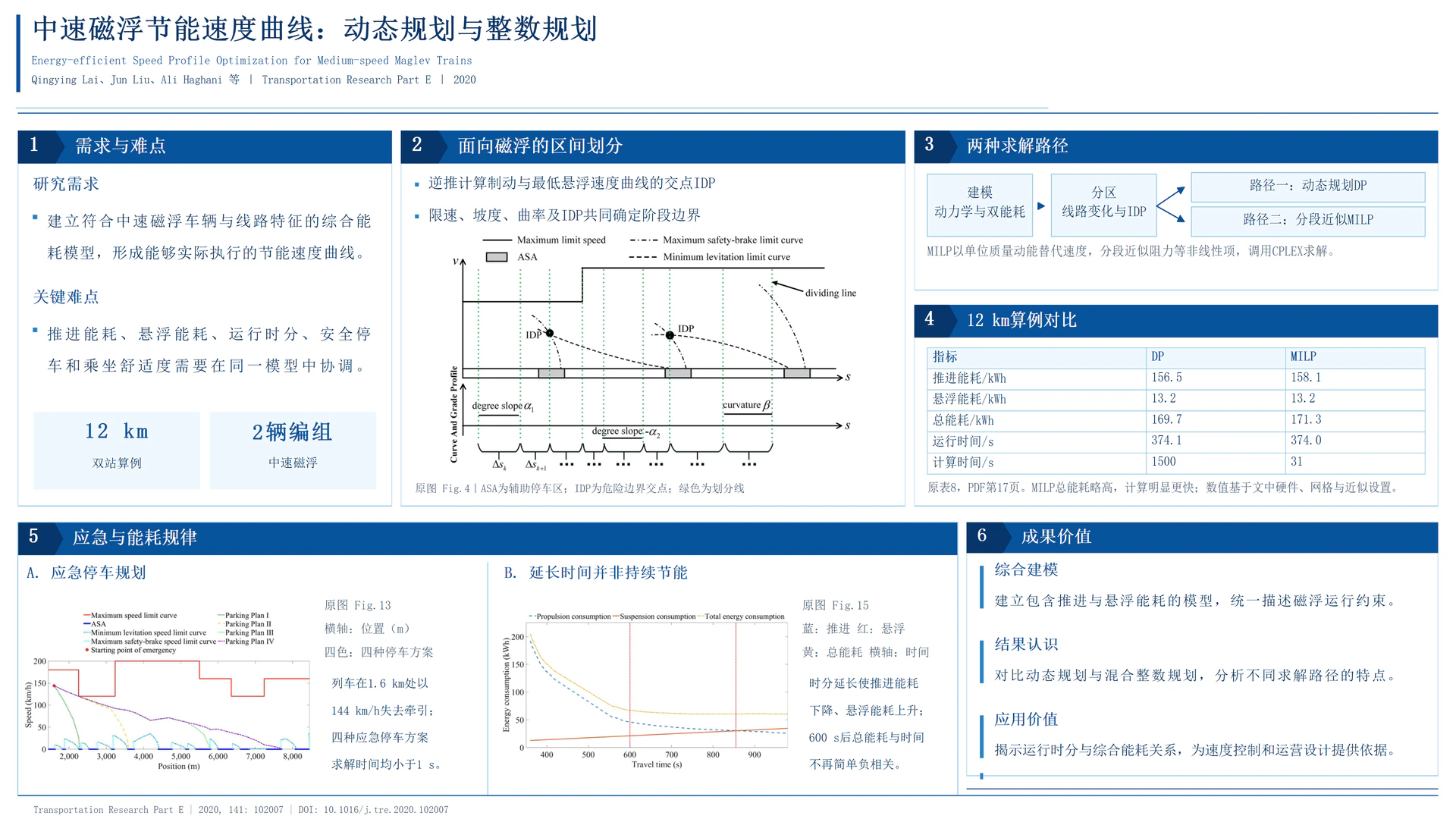
Energy-efficient speed profile optimization for medium-speed maglev trains
CONTACT THE TEAM
Faculty biographies and contact details are available on the official Beijing Jiaotong University profile pages.